The Hogwild! idea
the Diploma thesis learning – April 15, 2021
I have been working on a project based on the paper “HOGWILD!: A Lock-Free Approach to Parallelizing Stochastic Gradient Descent“.
https://papers.nips.cc/paper/2011/file/218a0aefd1d1a4be65601cc6ddc1520e-Paper.pdf
First iteration was reading the paper and preparing the logical model how Stochastic Gradient Descent, a.k.a. SGD, works and how it would be possible to paralelize.
Creating the Julia project
@everywhere function run_SSP_worker(batch, server, channel, model, ps, loss)
    id = myid()
    println("$(id) has started!")
    while fetch(channel) != nothing
        println("$(myid()) is bamboozled!")
        xs = take!(channel)
        println("$(myid()) has\n $(ps)\n $(xs)")
        data = batch()
        # WHY AM I NOT ALLOWED TO REMOVE MODEL HERE??
        gs = calculate_gradient(loss, model, ps, xs, data)
        information = Information(id, gs)
        println("$(data)\n # $(xs)\n # $(gs)")
        @sync put!(server, information)
    end
end
Math code is 
At first, we sample  in the
  ( is odd) equidistant points around
  :
:
![\[f_k = f(x_k),\: x_k = x^*+kh,\: k=-\frac{N-1}{2},\dots,\frac{N-1}{2}\]](https://school.moongames.eu/wp-content/ql-cache/quicklatex.com-453e8b590617b0bb07de5f80094c3d91_l3.png "Rendered by QuickLaTeX.com")
where
 is some step.
Then we interpolate points
 by polynomial
 (1) 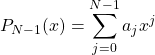
Its coefficients
 are found as a solution of system of linear equations:
 (2) 
Here are references to existing equations: (1), (2).
Here is reference to non-existing equation (??).